





























 |
Diptyque - Do Son Eau de Toilette - 50 ml spray
$88.00
Item 14529
|
|
|
It all starts in Tonkin in the thirties. Land of marshes and mists and
sweet-smelling summers, land of contrasts too; green grasses and precious
rice fields of the Red River Delta, the luxurious garden that feeds Hanoï,
set against the mountains all around...
Yves Coueslant grew up in Haiphong, a vast harbor in northern
Indochina where his father, a lawyer in love with China, was established. His
mother, hardly bearing the heat and damp monsoon weather, used to rest
for hours in the fresh and quiet half-light of her sitting room. She loved the
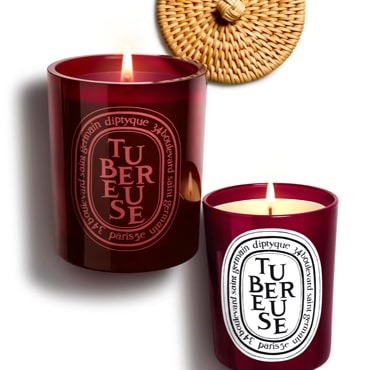
bitter sweet fragrance of tuberoses and the great department store in town
where she used to buy whatever was fashionable from Paris.
In the summer, the whole family used to retire to the fresh-aired mountains of Tam Dao.
It was so sultry at times in Haiphong, that his father had a small
pagoda built by the seaside, in Do Son. A small path bordered with
balustrades leads the way along the sea made purple by the ferruginous silt
from the Red River. In the background, the Along Bay and its 3000 islets.
The soft breeze on the terrace used to mingle with his mother’s fragrance
when she was near, and the scents of flowers in the heat.
Today, more than seventy years later, little has changed. The town
has spread around the old family house that has been turned into a hotel.
At Do Son, the pagoda and the balustrades of the small path along the sea
are still there. The evening breeze still carries all its mysteries along, soft
lulling exhalation, when the scents of heavy flowers and the seaside wind
gently mingle at the end of the day.
Yves Coueslant went back to Haiphong. Only once. Today he longs
to breathe in his mother’s precious fragrance once again. The Vietnamese word
for tuberose “cây hoa hûe” shows its likeliness to our western lilies.
Same white, all pure and virginal, yet its fragrance, somewhat
heady after sunset, evokes much more sensuous dreams.
At the time of the Italian Renaissance, young maids were forbidden to walk
around tuberose gardens lest they should get dizzy with the scent.
In Vietnam, tuberoses are devoted to worship. They are sold on
markets, armfuls of them wrapped in large canna leaves either alone or
with jasmine and ylang-ylang, as an offering.
The Tuberose belongs to the liliaceae family. Both a flower and a
plant, it bears a great number of small trumpet-shaped buds, all white as
white can be. Its fragrant molecules constantly renew themselves, for more
than forty-eight hours after the flower has been being picked.
Return to DIPTYQUE MAIN page
|